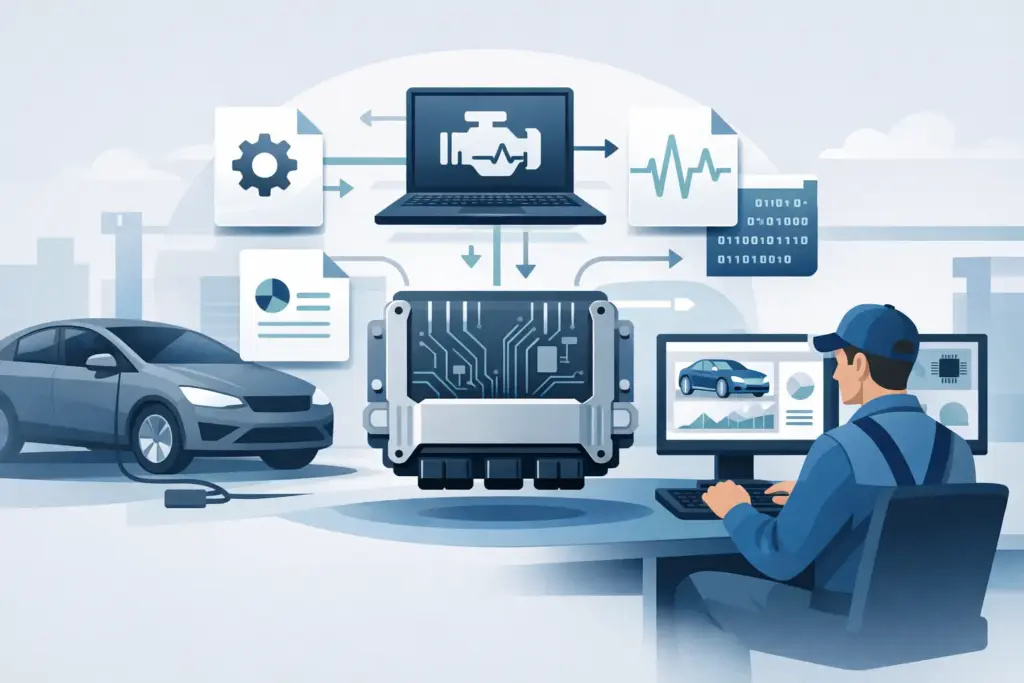
A customer doesn't come to a workshop to buy a "file". They buy noticeably better throttle response, power available where they actually use it, and the confidence that the car won't come back on a tow truck after collection. This ECU file guide organises the process that determines the outcome of the service: from identifying the control unit to checking the car after flashing. There's no room for guesswork in tuning. The same engine, but with a different software number, ECU version or equipment, may require a different calibration.
For a workshop, a ready-made file is a tool for scaling the service. It lets you complete jobs faster without building a calibration team from scratch or an expensive map development setup. There is one condition: the file must be prepared for the specific read, and the installation process must be repeatable.
An ECU file is a dump of data from the engine control unit. It contains both the areas responsible for running the software and the calibrations that control, among other things, fuel quantity, boost pressure, torque, ignition, temperature limits and component protection strategies. Not every read looks the same. Depending on the control unit, tool and operating mode, it may be a read via OBD, Bench, Boot or a full backup.
This distinction matters in practice. A read performed via OBD may be enough to safely handle many popular units, but it doesn't always contain the full set of data needed for recovery after a failed write. A full backup provides a greater safety margin, especially with control units prone to locking or in cars with an unknown modification history.
A professional tuning file isn't a mechanical raising of a few limiters. It's a set of changes that must work together within the capabilities of the stock engine, turbocharger, fuel system, clutch, gearbox and cooling. If a modification increases requested torque but ignores exhaust gas temperature, actual fuel pressure or gearbox limits, the problem doesn't go away. It's just postponed.
The most common workshop mistake doesn't happen during flashing. It happens earlier, when a car is qualified for tuning solely on the basis of model, year and claimed power. That's not enough.
Before ordering a file, check the vehicle's technical condition and the complete identification data. What matters is the ECU hardware number, software number, control unit version, VIN, gearbox type and the car's actual configuration. It's also worth establishing whether the car has a stock intake and exhaust system, whether there are any active faults, and whether someone has previously flashed an unknown modification.
In a diesel, the basics are assessing injector corrections, the condition of the boost system, intake tightness, DPF condition and fuel parameters. In a petrol engine, ignition corrections, knock, AFR or lambda, fuel pressure and intake temperatures become particularly important. A car with a mechanical problem doesn't become healthy after a map change. On the contrary - extra torque and load can expose a fault sooner.
Proper qualification protects the workshop's margin. Instead of losing hours diagnosing post-tuning complaints, you can clearly tell the customer right away that a leak, fuel problem or boost system fault must be fixed first. That isn't blocking a sale. It's professional risk management.
Before flashing, archive the original file along with the car's data and identification report. The stock read isn't only needed when the customer wants to return to factory settings. It also lets you confirm which software you're working with, compare changes and recover the control unit if something goes wrong.
Don't assume that a file downloaded from a database or taken from another car is right just because the engine code matches. Differences in software versions, checksums, memory, immobiliser or torque strategies can turn a seemingly simple job into a costly repair. The file must match the read from the specific car, not a description in an ad.
A cheap "Stage 1" often sounds attractive until you have to explain to the customer why the car smokes, jerks, overheats or has limited torque in higher gears. A universal map copied between control units may raise values without understanding how a given ECU strategy interprets driver requests and protection limits.
A calibration prepared by an engineer takes the relationships between maps into account. In a diesel, this means, among other things, consistency of requested torque, injection quantities, rail pressure, air and boost. In a petrol engine, the relationships between load, ignition, fuel, temperature and knock protection are critical. The result on the graph matters, but equally important is how the car builds torque, behaves under full load and responds in different conditions.
A dyno is a verification tool, not marketing decoration. It helps assess the gain, the power and torque curves, and repeatability. However, it doesn't replace road diagnostics and log analysis. Parameters such as EGT, AFR, actual boost, fuel pressure, temperatures and ignition corrections show whether the result achieved is technically justified.
Not every engine should get the maximum possible gain. In a fleet car, the priority may be flexibility and economical operation, while in a car with an automatic gearbox - torque that stays within the gearbox's limits. In a high-mileage vehicle, a conservative calibration is often more sensible than an aggressive result that only looks good in the offer.
A prepared file doesn't relieve the workshop of responsibility for a correct programming process. The best calibration won't help if the voltage drops halfway through the write or the wrong protocol is selected.
Ensure a stable power supply. A battery maintainer or a workshop power supply with adequate capacity is a mandatory part of the setup, not an extra. A battery that "somehow copes" is no safeguard when programming an ECU. Switch off electrical consumers, don't accidentally lock or unlock the car, and don't run other diagnostic procedures during the write.
Before flashing, verify the file size, identification match and checksum correctness if the tool you're using doesn't handle them automatically. After flashing, read the identification, clear any faults generated during programming and start the engine. Then check the basic parameters at idle and during a test drive under load.
In practice, it's worth establishing one procedure in the company for every job. A separate folder for stock reads, clear file naming, a record of the job number, a copy of the identification and a note on the programming method used eliminate chaos. When a customer comes back months later asking about the stock file or further modifications, you won't be searching for data on personal computers.
The end customer should hear specifics, but not promises detached from the technology. Instead of claiming an identical gain for every car, communicate a range and the conditions for achieving the result. Fuel, the car's condition, ambient temperature, equipment and measurement method all play a role.
A well-sold service primarily describes the change in driving: better flexibility, easier overtaking, quicker throttle response and torque available in a usable rev range. If the goal is lower fuel consumption, be clear: potential savings appear with the same driving style. More power used more often won't reduce fuel consumption.
Don't build your offer on removing systems responsible for emissions or safety. That's a legal, diagnostic and reputational risk that a professional workshop shouldn't pass on to the customer. Tuning should improve the performance of a healthy car, not mask faults or circumvent type-approval requirements.
Creating maps in-house requires time, experience, equipment, access to data and responsibility for every calibration decision. For many workshops, a more profitable model is one where the team focuses on diagnostics, correct reading, flashing and customer service, while calibration work is handed over to a trusted partner.
That's how a scalable service works. The workshop takes in the car, qualifies it technically, reads the ECU, sends the data for file preparation, and then carries out the flashing and checks. Shorter turnaround means more jobs handled, and a predictable process reduces the cost of rework. At SZARBI, files are prepared for the specific read and verified in terms of engine operating parameters, not just the claimed gain.
A workshop's best advertisement isn't the highest number in an ad. It's a customer who feels the difference after collecting the car, comes back for more services and recommends the shop to others, because the modification works exactly as it was sold.


