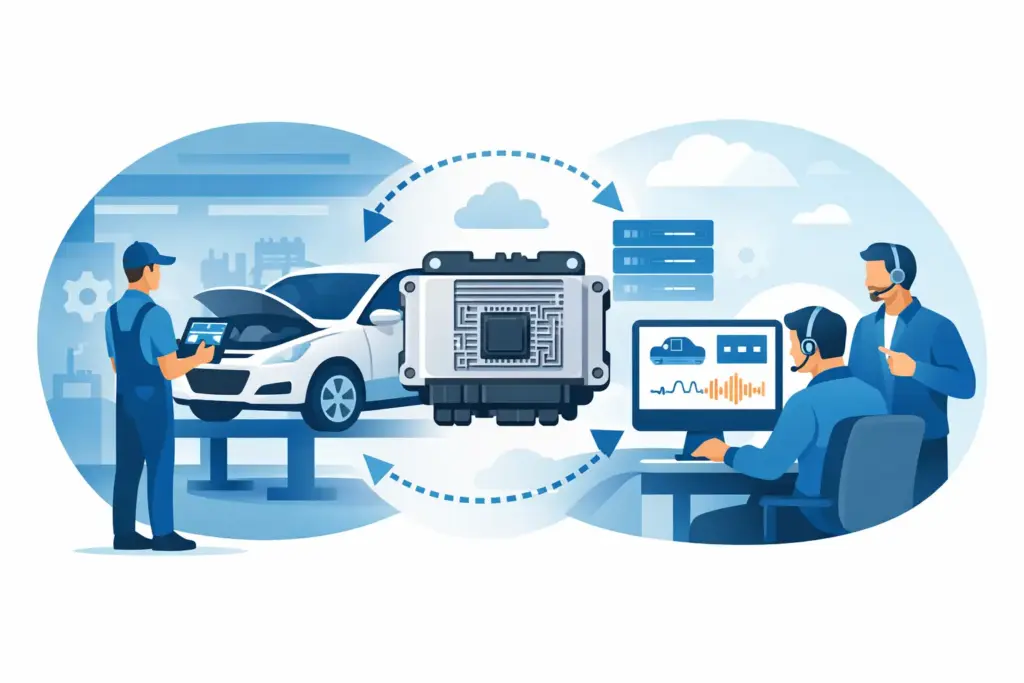
A customer arrives with their car expecting noticeably sharper throttle response and more torque, and the workshop has one question: can it deliver results quickly, without risking the engine or its own reputation? ECU calibration outsourcing solves this problem when a workshop can correctly read and write the ECU but doesn't want to build a team of calibrators, a dyno and a database of verified projects from scratch.
This is not a technical shortcut. It's a division of expertise. The workshop handles diagnostics, deals with the customer, performs the read and write, and takes responsibility for proper implementation. The external calibrator prepares a file for the specific vehicle, ECU number and software version. When both sides do their job well, the end customer gets an efficiently delivered service, and the workshop expands its offering without tying up capital in expensive infrastructure.
The best candidate for this model is a workshop that already has tools for working with ECUs or plans to move into vehicle electronics, but doesn't want to experiment on customers' cars. Reading a file with a programmer is only part of the process. Real calibration requires knowledge of the specific ECU's strategy, identification of torque, boost, fuel and limiter maps, and control of the relationships between them.
Building calibration expertise in-house makes sense for companies handling very high volumes, employing experienced engineers and willing to invest in testing. In every other case the maths is simple: the cost of a single, well-prepared file is predictable, while the cost of a faulty calibration can include warranty claims, damaged components and the loss of a customer who won't come back.
Outsourcing also lets you handle a wider range of vehicles. A single workshop can take on a popular diesel with a Bosch ECU, a petrol car with MED17, a commercial vehicle or a car with a more demanding ECU, without claiming to know every ECU family equally well. The key, however, is passing on the right data. A file without information on the HW and SW numbers, ECU type, mechanical modifications and the customer's expectations provides no basis for precise work.
The cheapest offer on the market often looks tempting until a problem appears. A file described as a universal Stage 1 may be based on a different software version, a different engine variant or a completely different hardware configuration. Differences between ECUs may be invisible at first glance, but in calibration they are critical.
A professional provider starts by verifying the original read. They check the file structure, ECU identification and software compatibility. They then prepare the changes so that the ECU continues to manage torque, fuel quantity, boost pressure and protective limits logically. It's not about the highest number on the chart. It's about a repeatable result that doesn't push parameters beyond the engine's reasonable operating range.
On a diesel, you need to look at, among other things, exhaust gas temperature (EGT), boost pressure, injection quantity, injection timing and torque limits stored in multiple places within the ECU strategy. On a petrol engine, AFR or lambda, knock control, ignition timing, intake air temperature and turbocharger load become particularly important. Increasing power without controlling these relationships isn't tuning. It's guesswork.
That's why the file should match the car's actual condition. A car with an intake leak, a fuel system problem, a worn turbo or fault codes stored in the ECU is not a candidate for safely increasing performance. Diagnose and fix faults first, then modify. A workshop that sticks to this order sells quality, not promises.
Well-organised outsourcing doesn't slow down the job. On the contrary, it eliminates downtime caused by manually hunting for maps or correcting unreliable files. The process should be simple but disciplined.
First, carry out full vehicle diagnostics and assess its condition. Read fault codes, check basic live data, verify the intake and fuel systems, and on turbocharged cars pay attention to actual versus requested boost pressure. If the customer expects a specific result, establish whether the car is stock or already has a modified exhaust, intake, intercooler or other components affecting the engine's operating strategy.
Then perform a safe read of the original file following the procedure for the given ECU. Keep the stock file in an organised archive. This is a foundation, not a formality. The original file lets you return to factory settings, resolve any problems and maintain control over the vehicle's history.
When ordering, send the read along with the vehicle and ECU identification, HW and SW numbers, and a short description of the technical condition and modifications. Once you receive the modified file, check its compatibility with the read and with the tool you use. Then write it with a stable power supply, following the correct procedure for OBD, bench or boot mode.
After programming, don't stop at the "write OK" message. Clear fault codes, start the engine, read parameters and take a test drive. Depending on the car, it's worth recording logs to compare boost pressure, fuel quantity, trims, temperatures and engine behaviour under load. This is the stage where the workshop confirms that the file's results match reality on the road.
The most visible benefit is time. Instead of turning the customer away or postponing the service indefinitely, the workshop can accept the car, prepare the read, order the calibration and move efficiently to implementation. Shorter turnaround means higher bay throughput and a better customer experience.
The second benefit is margin. The workshop isn't selling just a file. It's selling a complete service: pre-modification diagnostics, correct programming, post-write checks, knowledge of the specific car and responsibility for communicating with the owner. Access to proven calibration support makes it possible to price this service fairly, without the fixed costs of an in-house R&D department.
The third benefit is reputation. The customer doesn't remember the map name or the ECU communication protocol used. They remember whether the car drives predictably, whether the improvement is noticeable and whether they're back with a problem a few weeks later. A safe, well-tuned calibration generates referrals far more effectively than aggressive, unsubstantiated power claims.
SZARBI works exactly in this model: it supplies workshops with files prepared for the specific vehicle and ECU, with a focus on software compatibility, engine operating parameters and fast implementation using popular programmers. It's a partnership for workshops that want to sell chiptuning as a professional service, not test random solutions on customers' cars.
Outsourcing does not relieve the workshop of technical responsibility. Never program a car with active faults just because the customer is pushing for a deadline. Nor should you promise the same gains for every vehicle. Results depend on the engine version, component condition, fuel, operating conditions and modifications made.
A separate boundary concerns solutions that interfere with emission control systems or vehicle security. Workshops should operate in compliance with applicable regulations and not present such interventions as a standard performance service. Professionalism also means telling the customer "no" when their expectations are technically unreasonable, illegal or risky for the car.
It's also worth communicating the scope of the service clearly. If a customer comes in for Stage 1, they should know what to expect: better flexibility, sharper throttle response and increased torque within reasonable limits for stock hardware. Unnecessary promises of record figures create a problem that even the best file won't fix later.
Good ECU calibration outsourcing starts with choosing a provider, but ends in the bay of your workshop. Ensure a correct read, complete vehicle data, stable programming and post-implementation checks. Then a ready-made file becomes not a cost but a tool that lets you serve customers faster, protect your reputation and build profit on a service done the way it should be.


